Total Pageviews

Powered By Blogger
My Ping in TotalPing.com
Ping your blog, website, or RSS feed for Free

Popular Posts

Wednesday, January 4, 2012

Minimally Invasive Surgery (MIS) Procedures in Urology

Minimally Invasive Surgery (MIS) Procedures in Urology

Overview
Where to Seek Treatment
Return to Minimally Invasive Surgery main section
Singapore General Hospital
Dept of Urology

Overview

Robot-assisted laparoscopic surgery (or Da Vinci robotic surgery) is a minimally invasive surgical technique for complex urological surgery. It has been used in our centre for radical prostatectomy (prostate gland removal), nephrectomy (kidney removal), and pyeloplasty (repair of narrowed ureters), amongst others.


Da Vinci robotic surgery is the minimally invasive technique of choice for complex urology procedures.


The key benefits of robotic surgery include faster recovery from smaller incision wounds and less pain, lower blood loss and reduced need for transfusion, better vision and tissue dissection from a magnified view and use of special robotic instruments.

In patients who need radiation therapy, brachytherapy (seed implant) is a minimally invasive option where permanent radioactive tiny rice grainsized seeds are inserted through the skin in the perineum (between the scrotum and anus) under ultrasound guidance.

The Da Vinci is a highly sophisticated robot system that mimics the surgeon’s vision and hand movements.

Rick Santorum and Medicare: Last Ryan-backer left standing?

Rick Santorum and Medicare: Last Ryan-backer left standing?


(Steve Pope - GETTY IMAGES)

A funny thing happened when Rick Santorum nearly tied Mitt Romney in Tuesday night’s Iowa caucus: The Republican presidential hopeful who has most ardently argued for privatizing Medicare made an incredibly strong showing in the Hawkeye State.

Medicare is usually the third rail of electoral politics. Voters don’t like changes to the entitlement program, even when politicians suggest expanding it. And Iowa isn’t exactly a prime location to roll out big Medicare changes: Seniors make up 14.9 percent of the population there, compared with their 13 percent share nationally.

But that didn’t scare off Santorum. The former U.S. senator from Pennsylvania has, for months now, aggressively backed the Medicare changes that House budget chairman Rep. Paul Ryan (R) rolled out in April. That would be the plan that proposed privatizing the program and giving qualified recipients federal money to purchase health coverage. The plan was a political flop. Polls found that voters weren’t exactly keen to scrap the entitlement program as it exists now.

Most Republican candidates approached the Ryan plan with caution, if not outright criticism. Former House speaker Newt Gingrich didn’t mince words when he described it as “right-wing social engineering.” Mitt Romney, while praising the principles of the Ryan plan, ultimately proposed another version of Medicare reform, which would have a government-run plan compete against private options. And that looks a lot like the plan that Ryan, partnered with Sen. Ron Wyden (D-Ore.), rolled out last month.

But all along, Santorum has stood out in the GOP field as the Ryan plan’s biggest cheerleader. The day after Ryan rolled out his original plan, Santorum praised the House budget chairman’s ideas.

“I commend Chairman Ryan’s long-term budget proposal that tackles entitlement programs, particularly his proposed reforms of the Medicaid program,” Santorum said in a statement. “I also believe the Republicans’ approach to reforming Medicare is right on target to streamline the program, reduce waste and allow future Medicare beneficiaries to have more of a say in the needs of their benefits with a market driven approach.”

Santorum has endorsed the Ryan-Wyden plan, too. But he has also argued against the exact policy feature that makes the plan politically palatable: the guarantee that the government-run Medicare of today will still be around tomorrow. The day before the Iowa caucus, Santorum criticized the idea of public option in the Medicare program during a town hall speech. “I have a problem with the public option part that Ron Wyden has insisted on,” Santorum told Iowa voters.

In other ways, too, Santorum has gone against the political grain on Medicare. Last spring he described his vote to create Medicare Part D, a prescription drug coverage plan, as a mistake because it expanded the entitlement program. Most Republicans see the drug program as a success, one that has come in under budget as private health plans compete for seniors’ business, all the while getting high marks from the elderly population it serves.

How does a candidate who wants to make big changes to Medicare find himself with a near-first place finish in Iowa? Santorum’s Iowa success may have little to do with Iowans’ opinions on his Medicare policy. Instead, it could be that Hawkeye voters weren’t thinking much about health policy at all. Early exit polls showed that just 4 percent of Iowa voters considered health care as their biggest concern. Nearly a third of Santorum voters listed abortion as their key voting issue.

Santorum never weathered much of an attack for his views on Medicare in the way that other Republicans have faced (Exhibit A: The NY-26 special election last spring, where Democrats defeated a GOP contender with aggressive attacks on her support for the Ryan plan). And he hasn’t gotten much attention for his Medicare policy from his campaign competitors or even from Democrats.

But the former senator’s could see his Medicare proposals come under more scrutiny, as voters take a fresh look at the Republican field coming out of its first electoral contest
.

Iowa caucus results: Mitt Romney wins by a whisker over Rick Santorum

Iowa caucus results: Mitt Romney wins by a whisker over Rick Santorum

Iowa caucus results show Mitt Romney beat Rick Santorum by eight votes. Now, the importance of the South Carolina primary grows.

By Linda Feldmann, Staff writer / January 3, 2012

Iowa caucus results: Supporters of Republican presidential candidate and former US Sen. Rick Santorum cheer at the candidate's rally in Johnston, Iowa, Tuesday.

John Gress/Reuters

Enlarge
DES MOINES, IOWA

Moderate former Massachusetts Gov. Mitt Romney just barely edged out surging conservative former Sen. Rick Santorum of Pennsylvania in the Iowa Republican caucuses. The two candidates from different wings of the party were locked in a near-tie: each had 24.5 percent. Only 8 votes separated the two.


The close finish for the top two spots means the Republican nomination race leaves Iowa with an air of indecision. Next up is the
New Hampshire primary on Jan. 10, where Mr. Romney is expected to win easily. But his status as a favorite son there could diminish the meaning of such a victory.The libertarian-leaning Rep. Ron Paul of Texas to finish third, with 21.5 percent. Former House Speaker Newt Gingrich is in fourth with 13.3 percent. Texas Gov. Rick Perry is fifth with 10.3 percent. Rep. Michele Bachmannis sixth with 5.1 percent.

Election 101: How an Iowa GOP caucus works

The third race, the South Carolina primary, on Jan. 21 could prove crucial. It is the first contest in the South, and as such, does not favor Romney, a northerner. And some of the lower-tier candidates out of Iowa – such as Governor Perry and Congresswoman Bachmann of Minnesota – have announced they are skipping New Hampshire and heading straight to South Carolina.

As long as the field remains large and divided, that helps Romney. He is one of the only candidates in the race with the money and organization to last through a long slog through weeks of primaries and caucuses. But if he cannot build on his base of support, seemingly stuck in the mid-20s, that raises serious questions about how he gets to the nomination.

Mr. Santorum, in contrast, has stunning momentum. Just a month ago, he was polling below 5 percent among Iowa Republicans. But one by one, as other conservatives rose and were knocked down by gaffes and the intense focus on their records, Santorum seems to have timed his surge perfectly. The question for him is whether he can raise money and build an organization quickly enough to run a national campaign.

Meanwhile, Romney has signaled he is making a push in South Carolina, even before New Hampshire votes. Later this week, he heads to Charleston and Myrtle Beach for campaign events.

Iowa caucus result: as it happened

Iowa caucuses: Rick Santorum or Mitt Romney?
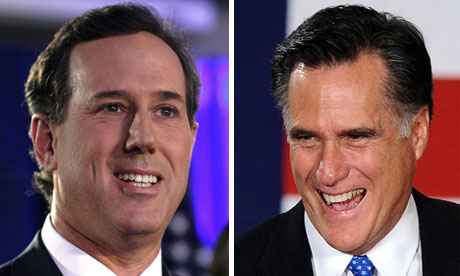
Neck and neck in the Iowa caucuses: Rick Santorum and Mitt Romney. Photograph: Jonathan Gress/Reuters/Jewel Samad/AFP

7.00pm: The 2012 GOP Iowa caucus is about to begin – it's all over bar the caucusing. And then the shouting. We will be bringing live results, analysis and speculation as they occur. How will the top three ofMitt Romney, Rick Santorum and Ron Paul finish? Does Rick Perry have a Texas Surprise under his big hat? Can Newt Gingrich's share of the vote match his sense of self satisfaction? And how many hours will elapse between the final result and Michele Bachmann's exit speech?

We will know the answers to all these questions and others in the coming hours. The caucuses themselves start at 8pm ET (1am GMT), and based on 2008 we should have the result by 11pm ET, or even earlier.

And don't forget that the Democratic party is also caucusing. It wn't be anything like 2008 of course but it's worth remembering that theRepublicans are not the only show in town.

The Guardian has correspondents in Iowa and New Hampshire, watching the results and talking to voters. And we have a raft of comment from the inestimable Ana Marie Cox.

And we want comments from you, the reader, right here. We'll be reading them all and passing the best jokes off as our own.

Read our earlier live coverage from today's campaigning in Iowa.

7.10pm: What are the five things to look for in tonights Iowa GOP caucus results?

1. The winners: Obviously, who finishes first is important. For an insurgent challenger such as Rick Santorum it's vital – no one remembers the second place finisher. Who finished second in 2008? Mitt Romney. Now, it's true that winning in 2008 didn't exactly make Mike Huckabee the nominee but without that "winner" title Huckabee would have faded into obscurity.

2. The losers: As they say, it's not the taking part that counts, it's the losing. Sixth place finish is almost certainly a ticket home – and that's most likely to be Michele Bachmann. But what about the fourth and fifth places? There's losing and there's losing: third place by a whisker and third by a mile can make the difference between going to New Hampshire or becoming a Fox News studio guest.

3. Turn-out: How many Iowans made it to the caucuses after all the hoopla? For the Republicans the benchmark is the 118,400 in 2008 – a figure that paled alongside the Democrats total of 227,000. That has implications for the general election.

4. Republican base: The make-up of the Republican voters will tell an interesting story, particularly for the fortunes of Mitt Romney and Rick Santorum, both of whom need to expand their support outside their natural base of traditional Republicans (for Romney) and social conservatives (for Santorum).

5. Democrats: The Democratic party is also caucusing tonight, although there is no such drama, Barack Obama being unopposed other than by sundry unknowns. But the party is using the night as an exercise in motivating and turning out its base in Iowa.

That's it – Rick Santorum's campaign is obviously in trouble. He's dropped the sweater-vest at the 11th hour, reports Scott Conroy of RealClearPolitics.

Wednesday, June 29, 2011

Media in category "Benchmarks in England"

The following 51 files are in this category, out of 51 total.